Stardust and Story: How Humans Manufacture Meaning at the Edge of the Infinite

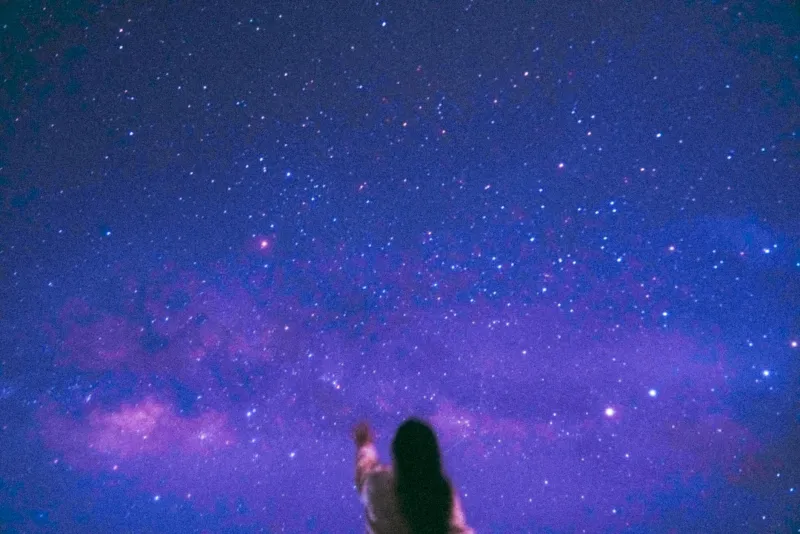
On a clear night far from city light — somewhere in the high desert of New Mexico, perhaps, or along the darkened coastline of Maine — the sky does something to a person. It does not comfort in the conventional sense. It does not reassure. What it does, if you allow it, is dissolve you. The stars recede into depths that arithmetic can name but the mind cannot truly hold, and somewhere in that dissolution, something unexpected often occurs: relief.
This is the paradox at the center of our cosmic situation. We are, by every measurable standard, negligible. The observable universe spans roughly 93 billion light-years. Our sun is one of an estimated two trillion galaxies' worth of stars. Earth's entire history — every empire, every elegy, every act of love or cruelty — occupies less than a cosmic eyeblink. And yet the species that produced both the hydrogen bomb and the haiku refuses, with remarkable consistency, to accept that none of it means anything.
The question worth sitting with is not whether the universe assigns us meaning. It almost certainly does not. The question is what it says about us that we assign it anyway — and whether that act of assignment is a weakness to be overcome or a capability to be honored.
The Tyranny of Self-Importance
Before we can appreciate the liberation that cosmic smallness offers, it helps to understand the prison that self-importance builds. Contemporary American culture is, in many respects, a monument to the self. From the relentless optimization culture of Silicon Valley to the therapeutic vocabulary of social media — where every opinion demands amplification and every grievance warrants a platform — we have constructed a world that treats individual significance as an axiom rather than a question.
The psychological costs are well documented. Anxiety disorders have surged. Rates of chronic dissatisfaction remain stubbornly high despite material conditions that would have seemed utopian to prior generations. Philosophers from Kierkegaard to Ernest Becker have argued, in different registers, that much of human suffering originates not from the world's indifference to us, but from our inability to tolerate that indifference. Becker's landmark work The Denial of Death proposed that virtually all human cultural activity is, at its root, a defense mechanism — an elaborate architecture erected against the terror of our own impermanence.
If Becker is right, then the burden we carry is not merely existential. It is structural. We have built civilizations on the premise that we matter absolutely, and that premise requires constant maintenance.
What the Void Actually Offers
Here is where the void — that concept so central to this publication's identity — becomes something other than a threat. Confronting cosmic insignificance does not have to mean surrendering to nihilism. It can mean something far more interesting: the deliberate release of the obligation to be central.
The Stoics understood this with characteristic precision. Marcus Aurelius, governing the most powerful empire of his age, returned repeatedly in his private journals to the exercise of viewing human affairs from an immense distance — what modern practitioners of Stoicism sometimes call the "view from above." The point was not to induce despair but to produce proportion. When you genuinely internalize that your career setback, your social embarrassment, your carefully nursed resentment, registers as nothing against the backdrop of geological time, something loosens. The grip of ego relaxes, if only momentarily.
Contemporary psychology has begun to formalize what the ancients intuited. Research on the emotion of awe — that particular quality of experience triggered by encounters with vastness — consistently demonstrates measurable reductions in what psychologists call the "small self." Studies conducted at institutions including UC Berkeley have found that awe-inducing experiences decrease self-referential thinking, increase prosocial behavior, and generate a sense of connection to something larger than the individual. In other words, feeling small makes people act bigger.
The Architecture of Invented Meaning
None of this dissolves the original problem. The universe remains silent on the question of our purpose. No cosmological discovery has ever returned with instructions. The silence, as this publication has explored before, is total.
What humans do with that silence is construct. We build narratives — religious, scientific, artistic, political — that impose coherence on an indifferent sequence of events. The philosopher Albert Camus called this the absurd: the collision between our hunger for meaning and the universe's refusal to provide it. His response was not resignation. It was defiance of a particular and disciplined kind. We must, he argued, imagine Sisyphus happy — not because the boulder stops rolling, but because the act of pushing becomes its own form of revolt against meaninglessness.
This is a harder position than it first appears. It requires holding two truths simultaneously: that nothing is cosmically guaranteed, and that the things we choose to care about are worth caring about precisely because we chose them. Meaning, on this account, is not discovered. It is made. And the making of it — in relationships, in creative work, in acts of service, in the sustained attention we give to other people — is not a consolation prize for a universe that withheld the real thing. It is the real thing.
Living Well Inside the Parentheses
There is a particular kind of freedom available to those who genuinely accept their cosmic irrelevance — not as a source of grief, but as a kind of permission slip. If the universe has no investment in your choices, then the choices are yours in a way they cannot be if some cosmic ledger is keeping score. The pressure to perform significance for an audience that does not exist simply falls away.
This is not a new insight, but it bears repeating in an era that markets meaning aggressively. Wellness industries, productivity frameworks, and self-actualization programs all implicitly promise that the right combination of habits and intentions will produce a life of sufficient weight. The cosmos, consulted honestly, suggests otherwise — and that suggestion is oddly freeing. You are not failing to optimize your way to significance. Significance was never on offer from that direction.
What remains, once the cosmic ledger is closed, is the texture of daily life: the quality of attention you bring to an ordinary Tuesday afternoon, the generosity or its absence in small interactions, the degree to which you are present for the people who occupy the same brief window of time as you. These things do not echo across the universe. They do not need to.
The Meaningful Accident
We are, as the physicist Carl Sagan observed, a way for the cosmos to know itself. That observation carries more weight the longer you sit with it. Consciousness — however it arose, whatever it ultimately is — represents the universe folding back on itself in reflection. We are the process by which hydrogen, given enough time and gravity, learns to wonder about hydrogen.
That is not nothing. It is not everything. It is, perhaps, exactly sufficient.
The void at the center of our cosmic situation is real. The silence is genuine. But the act of standing at the edge of that silence and choosing, deliberately and without guarantee, to build something — a relationship, a thought, a sentence, a life — is not a denial of the void. It is a response to it. And responses, however temporary, are the only form of meaning the universe has ever actually produced.
We did not ask to be here. We will not be consulted about our departure. In between, we get to decide what the parentheses contain. That, it turns out, is more than enough to work with.