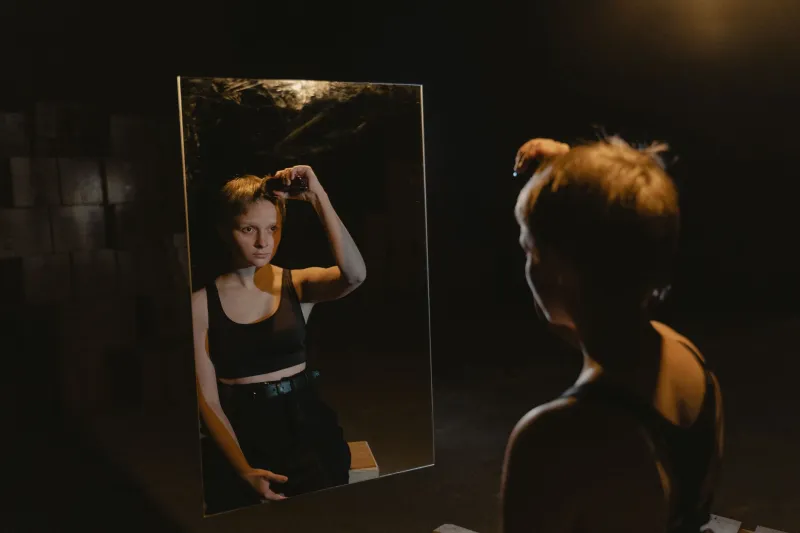
Never Final: The Psychological Cost of Living Life in Permanent Draft Mode

There is a folder most people never talk about. It sits inside every email client, every notes application, every messaging platform ever designed — the drafts folder. It is where language goes to wait. Where thought pauses before committing. Where meaning is held in suspension, not yet real enough to send, not yet wrong enough to delete.
At some point in the last two decades, we stopped keeping our drafts in a folder. We started keeping them inside ourselves.
The Language of the Unfinished
The digital world has handed us an entirely new grammar for describing incompleteness. Software ships as a beta. Products launch in early access. Social media posts sit in the queue, scheduled but not yet published. Entire identities exist in private-only mode — the Instagram account no one follows, the journal app no one reads, the voice memo recorded at 2 a.m. and never played back.
This grammar has seeped into the way Americans understand their own lives. Psychologists have long documented what is known as the arrival fallacy — the persistent belief that meaning and authenticity are located just beyond the next threshold. Once I finish school. Once I get the promotion. Once I lose the weight. Once I figure out who I actually am.
But something more specific is happening now. It is not merely that people defer happiness. It is that they have begun to understand their current existence as structurally temporary — a rough draft of a life that will eventually be edited into something worth publishing. The present tense has become a holding pattern.
Beta Humans in a Release-Candidate World
Consider the cultural weight we have placed on the concept of reinvention. American culture has always celebrated the self-made individual, the person who arrived from nowhere and built something from will alone. But there is a meaningful difference between growth and perpetual pre-launch.
Growth implies presence — a self that is genuinely here, genuinely engaged, genuinely accumulating experience. Perpetual pre-launch implies the opposite: a self that is always being prepared, always being optimized, always one update away from being ready to actually live.
The wellness industry, the self-improvement publishing market, the entire apparatus of personal development coaching — each, in its own way, profits from the idea that you are not yet the finished product. Every new framework, every morning routine overhaul, every personality assessment, functions as a kind of patch note. Version 2.0 of you is coming. Please stand by.
The philosopher Simone de Beauvoir wrote that existence precedes essence — that we do not arrive with a fixed nature waiting to be discovered, but rather construct meaning through the act of living. The draft-mode mindset inverts this entirely. It assumes that the essential self is already out there somewhere, fully formed, waiting to be uncovered once the conditions are right. Existence, under this view, is just the loading screen.
What Deletion Does to Memory
The impermanence is not only psychological. It is architectural. The digital infrastructure of modern American life is built around the erasure of evidence. Browsing histories vanish. Snapchat stories disappear after twenty-four hours. Unsent messages dissolve without record. The entire design logic of certain platforms is oriented around the idea that nothing need be permanent, that every version of yourself can be quietly deprecated.
This has consequences for how memory functions — and therefore for how identity coheres. Memory is not a passive archive. It is an active, constructive process. We remember in order to understand who we are. We build narrative continuity from the raw material of lived experience. When the digital record of daily life is systematically designed to disappear, that continuity becomes harder to sustain.
Researchers studying digital memory and identity formation have noted a troubling pattern: the more aggressively people curate and delete their online presence, the more unstable their sense of self-continuity tends to become. The past is not merely sentimental. It is structural. Without it, the present has no foundation, and the future has no trajectory.
The Void Between Versions
There is a particular quality of anxiety that belongs to this condition. It is not the sharp, object-directed anxiety of a specific fear. It is more diffuse — a low-level, chronic sense that the life currently being lived is not quite the real one. That the actual story begins later. That everything happening now is somehow preliminary.
This is the void that draft-mode living opens beneath ordinary existence. Not the cosmic void of deep space or the philosophical void of pure negation, but something smaller and more insidious: the void of the almost. The perpetual gap between the self that is and the self that is supposedly still loading.
People living inside this gap often describe a specific kind of disconnection — from relationships, from work, from physical experience. Why invest fully in anything that is, by definition, temporary? Why allow the present to matter when the future is where the real version of your life will finally begin?
The answer, of course, is that the future never becomes the present in the way the draft-mode mind imagines. The release date keeps slipping. The final version never ships. And the life that was being held in reserve — the authentic one, the ready one — was being lived all along, unnoticed, in the waiting room.
Committing to the Current Build
There is no clean philosophical prescription for escaping this condition. But there are ways of recognizing it — and recognition, as most serious inquiry into consciousness eventually concludes, is where transformation begins.
The first recognition is that incompleteness is not a temporary state to be resolved. It is the permanent condition of being a conscious creature in time. No amount of optimization, reinvention, or self-architecture will produce a finished self, because selves are not the kind of things that finish. They are processes, not products. They happen in the doing, not in the eventual arrival.
The second recognition is that the draft folder is a fiction. There is no unpublished version of you waiting for final approval. The messages you never sent, the person you were before the last reinvention, the life you are living right now while planning a better one — these are not rough drafts. They are the manuscript itself.
The cosmos does not wait for readiness. Stars do not hold themselves in reserve until conditions are optimal. They burn because burning is what they do, fully and without revision, until they do not.
There may be something instructive in that — a model of existence that commits entirely to the current build, not because it is perfect, but because it is the only one that is actually running.