The Fertile Void: Why Your Brain Needs Emptiness to Think

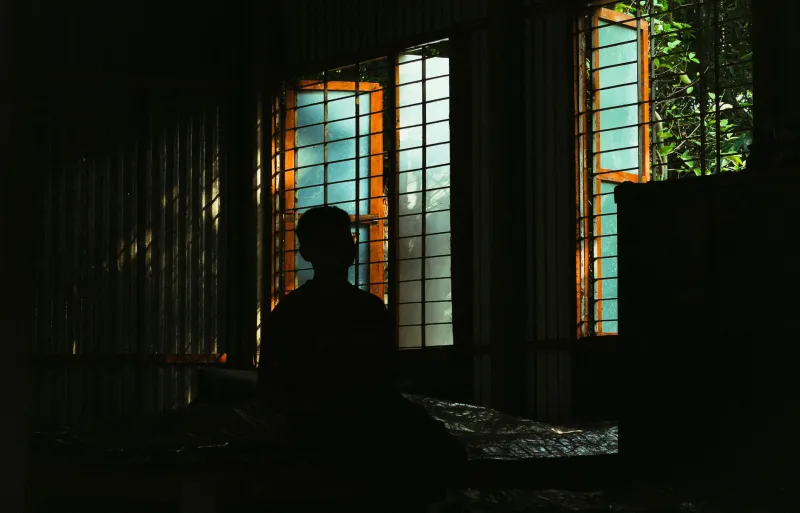
There is a particular discomfort that has become almost universal in contemporary American life: the feeling of doing nothing. Standing in line without reaching for a phone. Sitting in a quiet room without filling it with sound. Staring out a window without an agenda. These moments, once ordinary, have grown so rare that many people now experience them as a form of anxiety — a signal that something has gone wrong, that time is being wasted, that the self is somehow failing.
We have built an entire economy around eliminating those moments. Streaming platforms, notification systems, podcast feeds, infinite scroll — the architecture of modern digital life is specifically engineered to ensure that no gap in your attention goes unfilled. Productivity culture reinforces this further, treating the idle mind as a liability, a sign of laziness or lack of ambition. To be busy is to be valuable. To be still is to fall behind.
But neuroscience has been quietly assembling a counter-argument for years, and it points toward a deeply uncomfortable conclusion: the moments we have trained ourselves to eliminate may be the very moments our minds do their most essential work.
The Network That Wakes When You Stop
In the early 2000s, neurologist Marcus Raichle and his colleagues at Washington University in St. Louis identified something unexpected while studying brain activity. When research subjects were given no task to perform — when they were simply asked to rest — a specific constellation of brain regions did not go quiet. They became more active. Raichle called this the default mode network, and its discovery challenged the prevailing assumption that the resting brain was essentially offline.
The default mode network encompasses regions associated with self-referential thought, autobiographical memory, imagining the future, and understanding the mental states of others. In other words, when you stop doing, your brain begins thinking about you — who you are, where you have been, where you might be going, and how you relate to the people and world around you. Far from idling, it is performing some of the most sophisticated cognitive operations available to the human mind.
Subsequent research has linked default mode network activity to creative insight, moral reasoning, and the construction of a coherent personal narrative — the ongoing internal story that allows you to experience yourself as a continuous self rather than a series of disconnected moments. These are not trivial functions. They are, in many respects, the foundation of consciousness itself.
Boredom as a Threshold State
If the default mode network requires unstructured mental time to operate, then boredom — that uncomfortable, undervalued experience of having nothing external to engage with — may serve as the gateway through which the mind enters its most generative state.
Researcher Sandi Mann at the University of Central Lancashire has explored this terrain extensively. In studies where participants were assigned tedious tasks before being asked to engage in creative exercises, those who had experienced boredom consistently outperformed those who had not. The hypothesis is straightforward: boredom signals a deficit of stimulation, and the mind responds by turning inward, generating its own material, making unexpected connections between stored experiences and half-formed ideas.
This is the mechanism behind the shower epiphany, the highway revelation, the sudden clarity that arrives during a long walk. These are not coincidences or romantic myths. They are the default mode network doing exactly what it is designed to do once the noise clears long enough to let it function.
And yet, we have systematically dismantled the conditions that allow this to happen.
The Cost of Constant Stimulation
Consider what filling every idle moment actually costs. When you reach for your phone the instant a line slows, or plug in headphones the moment you step outside, you are not simply passing the time. You are interrupting a neurological process before it can complete itself. The default mode network requires sustained periods of low external demand to shift into productive operation. Brief flickers of downtime — the three seconds between notifications — are not sufficient. The mind needs duration, not just pauses.
The consequences extend beyond creativity. Research published in journals including Nature Neuroscience has connected impaired default mode network function to difficulties with empathy, reduced capacity for self-reflection, and a diminished ability to project oneself into hypothetical futures — the cognitive skill that underlies long-term planning, ethical reasoning, and genuine understanding of other people's inner lives.
There is also growing evidence that chronic overstimulation interferes with memory consolidation. The brain processes and integrates experience during periods of rest. When those periods are perpetually colonized by new input, the work of making meaning from what has already happened cannot proceed. You accumulate experiences without truly absorbing them — a condition that may help explain why so many Americans report feeling simultaneously overwhelmed and oddly empty.
Reclaiming the Void
The philosophical implications here reach further than productivity tips or wellness advice. What is at stake is something closer to the nature of consciousness itself.
The self, as neuroscience increasingly suggests, is not a fixed object but an ongoing construction — assembled and reassembled through the quiet, inward work of the default mode network. When we eliminate the conditions for that work, we do not simply become less creative or less focused. We become, in a meaningful sense, less fully ourselves. The narrative thread that connects past to present to imagined future grows thin and frayed. Identity becomes reactive rather than generative, shaped entirely by external inputs rather than internal synthesis.
This is where the cosmic dimension of the question becomes legible. Humans have always understood, in some intuitive register, that consciousness requires a relationship with emptiness. Contemplative traditions across cultures — from Zen Buddhism to the Christian mystical tradition to Indigenous vision quests deeply embedded in American history — have treated deliberate stillness not as absence but as encounter. An encounter with what lies beneath the surface noise of ordinary mental life.
Modern neuroscience, arriving from a very different direction, is reaching a surprisingly similar conclusion. The void is not where thinking stops. It is, in many respects, where thinking begins.
Sitting With the Discomfort
None of this is easy to act on. The discomfort of doing nothing is real, and the systems designed to fill that discomfort are powerful, well-funded, and extraordinarily good at their jobs. Reclaiming idle time is not a matter of willpower alone — it requires a conscious renegotiation with an environment that treats your attention as a resource to be harvested.
But the invitation is worth accepting. Not every moment of stillness will produce a breakthrough. Not every idle afternoon will resolve into revelation. What sustained practice does offer, however, is something quieter and more durable: a gradual reacquaintance with the texture of your own mind, the particular quality of your own thought, the inner landscape that exists beneath the constant feed.
The void, it turns out, is not something to escape. It is something to enter — carefully, willingly, and with the understanding that what waits on the other side of the silence may be the most genuinely human thing about you.