The Burden of Knowing: How Infinite Information Left Us More Lost Than Ever
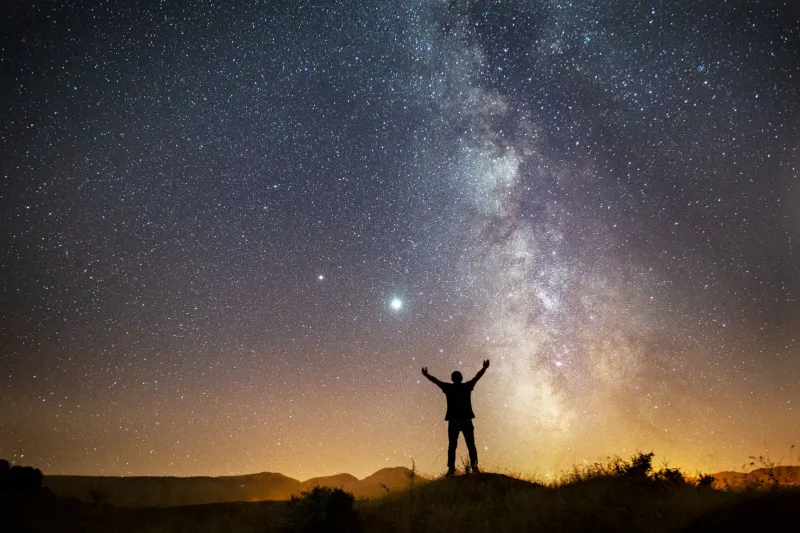
There is a particular kind of vertigo that arrives not in darkness, but in light. Not when we are ignorant of the cosmos, but when we are saturated with it. Today, a person with a smartphone and an internet connection can access decades of cosmological research, peer-reviewed studies on the nature of consciousness, real-time telescope imagery from the edges of the observable universe, and competing philosophical frameworks for the meaning of existence — all before finishing a morning cup of coffee. By any historical measure, we are the most informationally privileged generation of human beings who have ever lived. And yet, by nearly every psychological metric, we are among the most anxious.
This is not a coincidence. It is a paradox — and it deserves to be examined with the same rigor we apply to the data that produced it.
The Promise That Knowledge Would Settle Things
For much of Western intellectual history, the accumulation of knowledge was understood as a corrective to existential fear. The Enlightenment framed ignorance as the root of superstition, dread, and human suffering. Science, in this tradition, was not merely a method — it was a kind of salvation. The more we understood about the natural world, the argument went, the less power the unknown would hold over us.
That promise has not exactly been broken. It has simply turned out to be far more complicated than its architects anticipated.
Consider what we now know about the scale of the universe. The observable cosmos spans approximately 93 billion light-years in diameter. It contains an estimated two trillion galaxies. Our own galaxy, the Milky Way, harbors somewhere between 100 and 400 billion stars, and our sun is an unremarkable specimen among them. Earth, by extension, is a pale fragment orbiting an average star in the outer arm of one galaxy among trillions. These are not metaphors. They are measurements.
For earlier generations, the cosmos was largely theoretical — a canvas for theology, mythology, and philosophical speculation. Its vastness was implied rather than quantified. Today, that vastness is rendered in precise, peer-reviewed numbers. And something strange happens when the infinite becomes numerical: it stops being sublime and starts being destabilizing.
When More Data Produces Less Certainty
The philosopher of science Karl Popper observed that every answered question generates at least two new ones. This is not merely a charming observation about intellectual curiosity — it describes a structural feature of knowledge itself. Scientific advancement does not converge toward a final, settled picture of reality. It expands the frontier of the unknown even as it populates the known.
Quantum mechanics offers perhaps the most vivid illustration of this dynamic. Before the twentieth century, matter was understood to be solid, predictable, and governed by deterministic laws. Then physicists looked closer. What they found was a subatomic world defined by probability, superposition, and observer-dependent outcomes — a reality that resists the kind of stable, common-sense description that most human minds find reassuring. The closer we look at the fabric of existence, the stranger it becomes.
The same principle applies to cosmology. Dark matter and dark energy — phenomena we cannot directly observe but whose existence we infer from their gravitational effects — are now believed to constitute approximately 95 percent of the total mass-energy content of the universe. In other words, the universe we can see and measure accounts for roughly five percent of what is actually there. The more sophisticated our instruments become, the more we discover how much remains beyond our reach.
This is knowledge, certainly. But it is knowledge that expands mystery rather than containing it.
The Democratization of Cosmic Dread
What makes this moment historically distinct is not merely that these discoveries exist — it is that they are universally accessible. In previous centuries, unsettling cosmological and philosophical ideas were largely confined to academic institutions, theological seminaries, and the private libraries of the educated elite. The existential weight of Copernican displacement, Darwinian evolution, or Nietzschean philosophy was mediated by cultural institutions, religious frameworks, and the simple friction of limited access.
The internet has dissolved that friction entirely. A teenager in rural Kansas can now spend an afternoon reading about the heat death of the universe, the simulation hypothesis, the possibility that consciousness is an epiphenomenon of matter with no intrinsic meaning, and the latest arguments for and against free will — and then be expected to finish their homework. There is no institutional scaffolding built to process that volume of existential raw material. There is no cultural ritual designed to metabolize it.
What fills that vacuum, predictably, is anxiety. Not the productive anxiety of a philosopher wrestling with a difficult problem in a structured context, but the diffuse, ambient dread of a mind that has ingested more cosmological uncertainty than it has any framework to organize.
The Illusion of Resolution
Part of what makes this dynamic so insidious is that information feels like it should resolve things. Each new article, documentary, or scientific paper arrives with the implicit promise that it will bring clarity. And in narrow, technical senses, it often does. We learn more about how black holes form, what the cosmic microwave background tells us about the early universe, or how neurological processes correlate with subjective experience.
But clarity about mechanism is not the same as clarity about meaning. And meaning — the question of why any of this exists, why consciousness arose within it, and what any individual human life amounts to against the backdrop of 13.8 billion years of cosmic history — is precisely what scientific information is structurally unable to provide. It can describe the universe with breathtaking precision. It cannot tell you what to do with what it describes.
Previous generations were, in a sense, protected from this gap by the limits of their information. When the cosmos was smaller, more mysterious, and more readily populated with theological narrative, the question of meaning had ready-made answers — answers that, whatever their empirical shortcomings, were psychologically functional. They provided orientation. They offered a story in which human beings occupied a significant position.
The modern cosmological picture offers no such story. It offers data.
Learning to Inhabit Uncertainty
None of this is an argument for ignorance, nor a nostalgic appeal to pre-scientific frameworks. The knowledge we have accumulated is genuinely extraordinary, and the capacity to look honestly at the universe — even when what we find is disorienting — reflects something admirable about the human mind.
But it does suggest that the project of living well in an age of infinite information requires something that the information itself cannot supply: a cultivated tolerance for uncertainty. Not the passive resignation of someone who has given up on understanding, but the active, disciplined practice of holding open questions without demanding premature resolution.
The Stoics called this amor fati — the love of fate, including its unknowable dimensions. Contemporary psychologists might frame it as epistemic humility. Whatever the vocabulary, the underlying capacity is the same: the ability to stand at the edge of what is known, look out into the void, and remain steady.
Knowing everything about the universe, it turns out, is not the destination. It is merely the beginning of a much harder question — one that no database, however vast, will ever fully answer.