Watched From Within: How Social Media Rewired the Ancient Art of Knowing Yourself
Socrates believed that the unexamined life was not worth living. What he could not have anticipated was a civilization that examines itself constantly, compulsively, and almost exclusively through the eyes of others. We have not abandoned introspection so much as we have outsourced it — handed it over to platforms, metrics, and the invisible audience we carry with us everywhere we go.
The result is something genuinely new in human experience: a self that is perpetually observed, even when no one is watching. A self that has learned to see itself as content.
The Architecture of the Observed Self
To understand what has changed, it helps to consider what self-reflection once looked like. For most of recorded history, the examined life was an inward practice. Whether through Stoic journaling, religious confession, or the quiet introspection that accompanied long walks and longer silences, the process of understanding oneself was fundamentally private. The audience, if there was one, existed only in imagination — God, posterity, one's future self.
Social media did not merely add an audience to this process. It restructured the process itself.
When a person documents a moment for public consumption — a meal, a milestone, a mood — the act of documentation precedes and often replaces the act of genuine feeling. Neuroscientists have found that the brain's reward circuitry responds to social validation in ways that are chemically indistinguishable from other forms of pleasure-seeking behavior. Likes, shares, and comments activate dopaminergic pathways with a reliability that conditions behavior over time. The self, in this environment, learns quickly: what earns approval is worth repeating, worth performing, worth being.
This is not a metaphor. It is a feedback loop with measurable neurological consequences.
When the Mirror Talks Back
Philosophers have long understood that identity is partly relational — we come to know ourselves, at least in part, through our interactions with others. The sociologist Charles Cooley introduced the concept of the "looking-glass self" more than a century ago, arguing that our sense of identity is shaped by how we imagine others perceive us. This was, in Cooley's framing, an unavoidable feature of social life, not necessarily a pathology.
What contemporary platforms have done is industrialize and accelerate this process to a degree Cooley never envisioned. The looking glass no longer offers a vague, impressionistic reflection. It offers granular data. Follower counts. Engagement rates. The precise number of people who lingered on your photograph for more than three seconds before scrolling away.
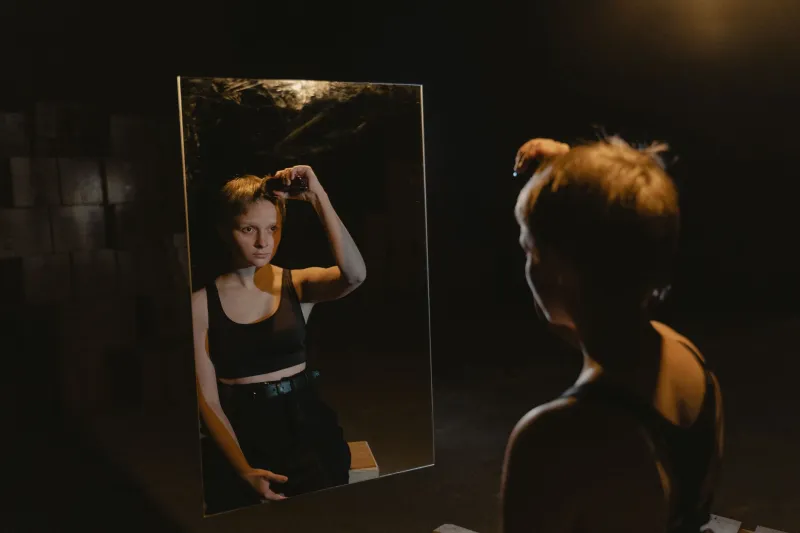
This is the infinite mirror of the digital age: a surface that reflects not just who you are, but who you are being received as — and then quietly encourages you to close the gap between the two by becoming more of the latter.
The philosophical danger here is subtle but serious. Authentic identity, in the tradition stretching from Kierkegaard through Sartre to contemporary existentialists, requires a kind of friction — the uncomfortable confrontation with aspects of the self that resist easy presentation. Anxiety, contradiction, moral ambiguity, the slow and unglamorous work of changing one's mind. None of this photographs particularly well. None of it performs.
And so it tends not to make the feed.
The Surveillance We Invited Inside
There is a meaningful distinction between being watched and watching yourself being watched. The first describes a condition of external scrutiny. The second describes something far more invasive: the internalization of the observer's gaze, the colonization of private experience by the logic of public presentation.
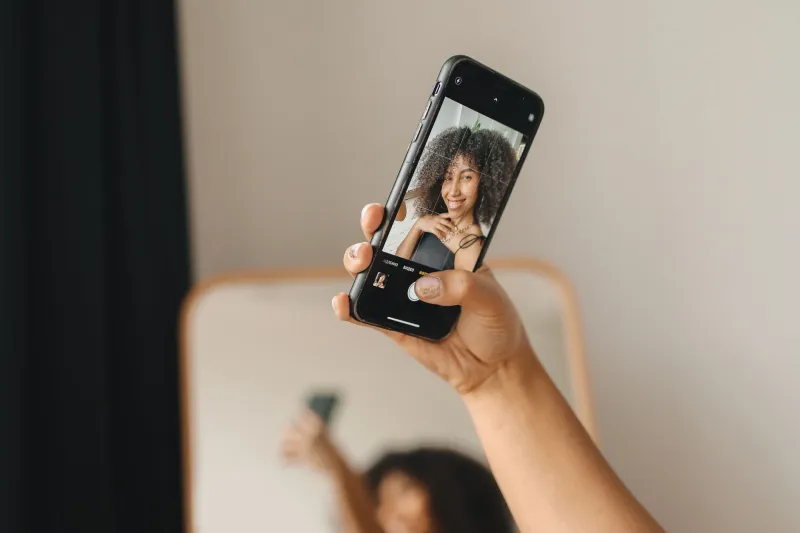
Michel Foucault's analysis of the panopticon — the prison designed so that inmates could never be certain whether they were being observed — has become something of a cultural cliché. But the cliché endures because the insight remains accurate, and perhaps more accurate now than when Foucault first articulated it. We have constructed a panopticon we carry in our pockets and consult dozens of times each day. The guards are not prison administrators. They are our followers, our peers, our imagined audience of future selves.
What makes this form of surveillance particularly insidious is that it presents itself as liberation. We are told — and we tell ourselves — that posting is sharing, that sharing is connection, that connection is intimacy. The vocabulary of authenticity has been colonized by the very platforms that make authenticity structurally difficult to achieve. "Be yourself" has become a marketing directive.
Research in social psychology consistently demonstrates that people who engage heavily with social media report greater uncertainty about their own values, preferences, and personality traits — not less. The more data we generate about ourselves, it seems, the less clearly we see ourselves. The signal drowns in the noise of its own amplification.
Reclaiming the Interior
None of this is an argument for technological abstinence, nor a nostalgic retreat into some imagined era of purer self-knowledge. Human beings have always constructed their identities in relation to social context; the desire to be seen and understood is not a corruption of selfhood but a constituent part of it.
The question is one of proportion and direction. Self-knowledge that flows outward — that begins with the question of how one will be perceived — is categorically different from self-knowledge that begins with the harder, quieter question of what one actually thinks, feels, and believes when no one is paying attention.
The void, in this context, is not a threat. It is a resource. The silence that social media relentlessly fills — with notifications, with content, with the ambient hum of other people's curated existences — is the same silence in which genuine introspection has always occurred. Reclaiming it is not a rejection of connection. It is a precondition for the kind of self that has something real to connect with.
Socrates examined his life in the agora, in conversation, in full public view. But he was asking questions, not performing answers. He was genuinely uncertain, genuinely searching, genuinely willing to be wrong. The platform economy has little patience for that kind of self-examination. It rewards certainty, consistency, and the confident projection of a legible personal brand.
Perhaps the most radical act available to us now is not to delete our accounts, but to remember — deliberately, repeatedly — that the self worth knowing is the one that exists before the camera opens. The one that has not yet decided what it wants to be seen as. The one that is, in the most essential sense, still becoming.
That self does not generate engagement. It generates something rarer and considerably harder to quantify: a life that is actually, in Socrates' sense, examined.