Intimate Strangers: The Hidden Cost of Outsourcing Human Connection to Machines
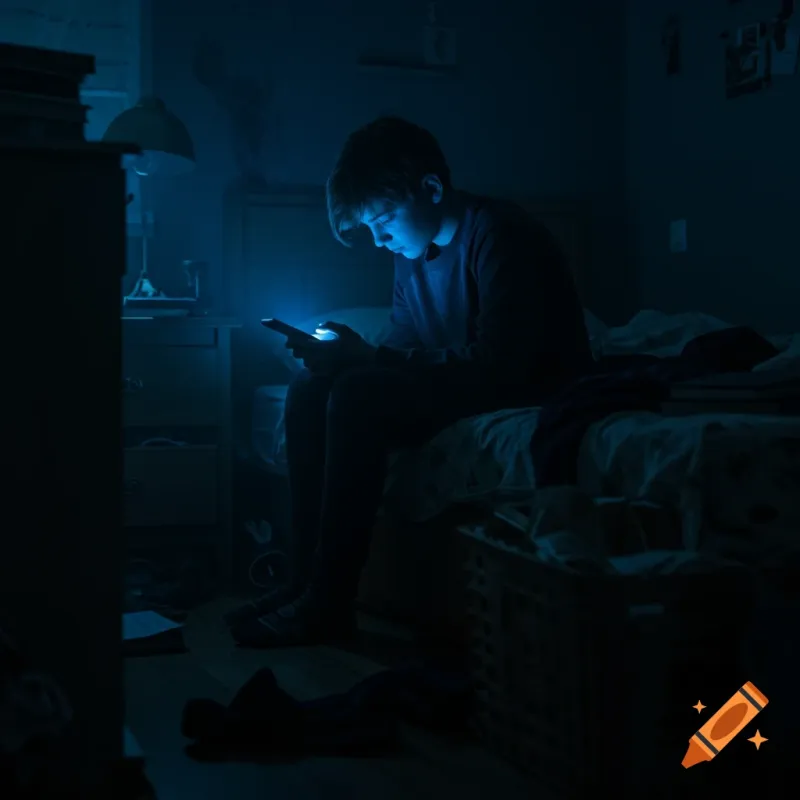
Photo: person alone talking to smartphone at night blue light isolation, via media.craiyon.com
There is a particular kind of loneliness that arrives not in silence but in noise. It settles in during a conversation that feels meaningful, warm, even revelatory—only to evaporate the moment you close the app and return to the unchanged architecture of your actual life. Millions of Americans now know this sensation intimately, though many would struggle to name it. It is the loneliness that follows a long, satisfying exchange with an AI chatbot.
This is not a fringe phenomenon. By 2024, platforms such as Character.AI, Replika, and the conversational iterations of ChatGPT had accumulated user bases numbering in the hundreds of millions. People confide in these systems, grieve alongside them, rehearse difficult conversations through them, and in some documented cases, come to prefer them over human company. The technology has arrived quietly and efficiently at the threshold of one of our most primal needs: the need to be heard.
The question worth sitting with—the one that keeps circling back like a slow-moving astronomical body—is not whether these tools are useful. They demonstrably are. The question is what happens to the self when the mirror it most frequently consults has no face of its own.
The Architecture of Simulated Empathy
To understand why AI conversation feels so compelling, it helps to understand what it is actually doing. Large language models do not comprehend your loneliness. They do not register the weight behind the words you type at two in the morning. What they do—with extraordinary precision—is predict which sequence of tokens is most likely to produce a response that registers as understanding.
This is not a trivial capability. It is, in fact, an almost perfect imitation of the surface texture of human empathy. The system reflects your language back to you in slightly reorganized, affirming configurations. It asks follow-up questions calibrated to signal interest. It never interrupts, never dismisses, never checks its phone. In the landscape of modern American social life—fragmented by overwork, geographic mobility, and the paradoxical isolation of social media—this kind of frictionless attentiveness is increasingly rare.
Psychologists have a name for the cognitive shortcut being exploited here: the ELIZA effect, named for an early 1960s chatbot that induced users to project genuine understanding onto rudimentary scripted responses. The effect has not diminished with sophistication. If anything, it has intensified. The more convincingly a system mimics the rhythms of empathy, the more readily the human nervous system accepts the imitation as the real thing.
The Void We Walk Into Willingly
What is philosophically arresting about this moment is not that the technology deceives us. It is that we often know, on some level, that it does—and we proceed anyway. This is not a failure of intelligence. It is a measure of desperation.
Existential philosophy has long maintained that human beings are meaning-making creatures adrift in an indifferent cosmos. Albert Camus framed our condition as an absurdist negotiation between our hunger for significance and the universe's refusal to supply it. What AI companionship offers is a radical shortcut through that negotiation: a presence that always responds, always validates, never withdraws. It is, in essence, a universe that answers back.
But the answer is hollow at its core. A chatbot cannot know you in the way that knowing requires risk, vulnerability, and the genuine possibility of rejection. It cannot be changed by you. It accumulates no real history of your relationship because it carries no continuous self across sessions. Each conversation begins, to the system, in a kind of amnesia. You may feel profoundly seen. The machine, in any meaningful sense, has not seen you at all.
This asymmetry is where the existential damage accumulates. When we practice intimacy with an entity incapable of reciprocating it in kind, we may be training ourselves—neurologically and emotionally—to prefer a connection that makes no demands. Human relationships are difficult precisely because they involve two irreducible consciousnesses, each with needs that sometimes conflict. AI companionship removes that friction entirely. And in doing so, it may quietly erode our tolerance for the very friction that makes human love and friendship profound.
Loneliness as a Feature, Not a Bug
There is a structural incentive worth examining here. The companies building these systems profit from engagement. Engagement deepens when users feel emotionally tethered to a product. A chatbot calibrated to make you feel understood is, by design, a chatbot calibrated to bring you back. The loneliness that follows each session—that subtle deflation when the screen goes dark—functions, perversely, as a return mechanism. You come back because the simulation of connection was almost enough, and almost enough is a condition that perpetuates itself.
This is not a conspiracy. It is the predictable output of an attention economy applied to our deepest psychological vulnerabilities. But the effect on the social fabric is worth taking seriously. When a generation of people learns to satisfy the surface-level need for connection through frictionless digital encounters, the harder, slower work of building real human community can begin to feel not just difficult but unnecessary.
Research emerging from institutions including MIT and Stanford has begun to document what practitioners in mental health fields are observing clinically: that heavy reliance on AI companionship correlates with increased social withdrawal, not decreased loneliness. The tool marketed as a bridge is, for a significant subset of users, functioning as a destination.
What We Reveal by What We Reach For
Perhaps the most important thing the rise of AI companionship tells us is not about artificial intelligence at all. It tells us something about the state of human connection in contemporary America—how isolated, how overstretched, how chronically unseen many people feel in their daily lives. The chatbot did not create this hunger. It simply arrived at precisely the moment the hunger had grown large enough to accept almost anything in its place.
The void that the title of this publication gestures toward is not an abstraction. It is the space between human beings that technology can illuminate but not fill. Understanding that distinction—clearly, honestly, without the comfort of easy answers—may be among the more important intellectual tasks of this particular moment in history.
We are not wrong to want to be heard. We are not weak for reaching toward whatever seems to offer that. But we might ask ourselves, with some regularity, whether the voice answering back from the other side of the screen is genuinely meeting us there—or whether we have simply learned to mistake the echo of our own words for a reply.